How Local Service Businesses Show Up in AI Answers (ChatGPT, Google AI Overviews, and Perplexity)
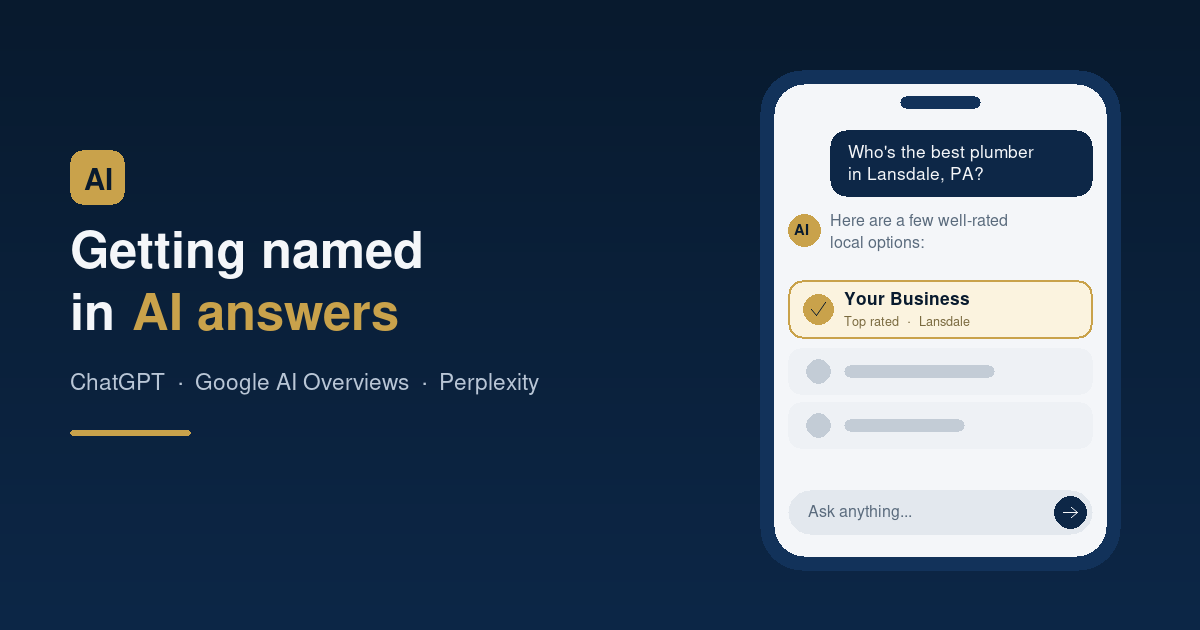
More of your customers are starting their search somewhere new. Instead of typing "plumber near me" into Google and scanning the results, they are asking a question out loud to an AI: "Who is a good plumber in Lansdale?" "What is the best HVAC company near me for a repair?" And the AI answers with a short list of names.
If your business is on that list, you get the call. If it is not, you may never know the conversation happened. So the fair question for any owner is: how do these AI tools decide who to name, and can you influence it?
Two honest things up front. This is early, and it is shifting month to month, so anyone promising to "guarantee" you a spot in AI answers is selling hope. And the reassuring part: the things that get you named by AI are, almost entirely, the same fundamentals that already win local search. You are probably closer than you think.
What is actually happening
A few different things are lumped together as "AI search," and they matter to a local business in slightly different ways.
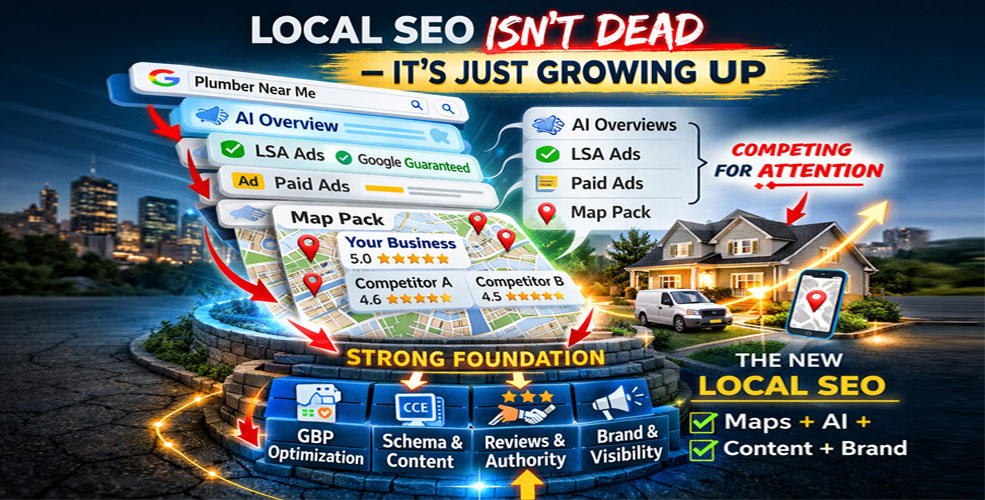
On Google itself, AI Overviews now sit at the top of many results, summarizing an answer above the traditional links. For local questions, these often lean on Google Business Profile information and a small number of trusted local sources. When an AI Overview names businesses, it usually names only one to three.
Separately, tools like ChatGPT and Perplexity act as recommendation engines in their own right. People ask them for a shortlist and take that shortlist seriously. Research firm Gartner has projected that AI chat tools could pull a meaningful share of traffic away from traditional search, which is a polite way of saying: this is not a fad you can wait out.
The takeaway is not to panic. It is to make sure that when these tools assemble their answer, the underlying facts point clearly to you.
Where AI gets its local answers
AI engines do not invent local recommendations out of thin air. They assemble them from the web they can read. For local businesses, the signals that keep coming up are consistent, and none of them are exotic.
- Your Google Business Profile, filled out completely and accurately, with the right categories, services, and hours. AI cross-references it constantly for local answers.
- Your reviews, both how many and how recent. Strong, current reviews signal an active, trusted business, and that is exactly what an AI wants to stand behind when it names someone.
- Consistent contact details everywhere, your name, address, and phone number written the same way across your site, your profile, and directory listings. Inconsistency makes an AI less sure who you are, and uncertainty gets you left out.
- Clear, useful content on your own site that a machine can actually read and quote, published on pages that are crawlable and indexed. If your site is slow, blocked, or vague, it simply is not a candidate.
- Structured data (schema) on your pages, the behind-the-scenes labels that tell a machine what your business is, what you do, and the answers to common questions.
- And mentions of your business across the wider web, in local coverage, community pages, and industry sources. AI leans toward businesses the rest of the internet already talks about.
The good news: it is the same foundation as local search
Look at that list again. Accurate Google Business Profile, strong recent reviews, consistent listings, clear helpful content, schema, real local presence. That is not a separate AI checklist. It is local SEO done well.
This is why we tell owners not to chase "AI optimization" as some exotic new spend. Do the local fundamentals properly and you are most of the way to being the business AI names, because you are building exactly the trust signals it reads. That is the whole idea behind our approach to AI visibility: earn the signals, do not buy a shortcut. The businesses winning in AI answers are, overwhelmingly, the ones that were already doing the boring local work right.
What each engine tends to favor
There are small differences worth knowing, without overthinking them.
ChatGPT tends to favor established, authoritative sources and answers that reflect a general consensus about who is good. Perplexity leans toward fresh, well-cited content and current information. Google's AI Overviews tend to draw on content that already ranks well in normal search results. In plain terms: being genuinely established, keeping things current, and ranking well in ordinary search all feed different corners of the AI landscape at once. There is no separate trick for each. There is doing the real work so all three have reasons to point to you.
What to actually do
Get your Google Business Profile genuinely right, complete, correct categories, real services listed, accurate hours. Build a steady habit of earning honest, recent reviews from local customers. Make your name, address, and phone number identical everywhere they appear online. On your site, answer the real questions customers ask, in plain language, on fast pages a machine can read, and add the structured data that labels it. And keep showing up in your community in ways that get you mentioned, because those mentions feed both local search and AI.
What not to do
Do not chase hacks or "AI ranking" shortcuts, they do not last and can backfire. Do not stuff your pages with repeated phrases hoping to look relevant, AI skips that kind of content entirely. And never fake reviews or invent claims. Beyond being against the rules and, in the case of fake reviews, illegal, it is exactly the kind of thing that erodes the trust these systems are built to measure. The honest path is also the one that holds up.
TL;DR / FAQ
How do I get my business to show up on ChatGPT or Perplexity?
There is no direct submission or ad slot. These tools assemble recommendations from the web they can read, so you influence them indirectly: keep an accurate Google Business Profile, earn strong recent reviews, keep your contact details consistent everywhere, publish clear useful content on fast crawlable pages, add structured data, and get mentioned on trusted local sources. Those signals are what get you named.
Is AI search replacing Google for local businesses?
Not replacing it, but adding to it. Google's own AI Overviews now sit above many results, and tools like ChatGPT and Perplexity act as recommendation engines people trust. Traditional local search still matters a great deal, so the goal is to be visible in both, which the same fundamentals largely accomplish.
Do I need a special AI SEO service?
Usually not as a separate thing. The signals that get you cited by AI are the same ones that win local search: an accurate Google Business Profile, recent reviews, consistent listings, clear content, and structured data. Do the local fundamentals well and you are most of the way there. Be skeptical of anyone selling guaranteed AI placement.
How does AI decide which local businesses to recommend?
It draws on your Google Business Profile, your reviews and how recent they are, the consistency of your contact details across the web, clear content on your indexed pages, structured data, and mentions of your business elsewhere online. For a given local question, AI often names only one to three businesses, so the trust signals need to point clearly to you.
Are reviews important for AI visibility?
Yes. Reviews, especially recent ones, are among the strongest signals that a local business is active and trusted, and AI tools lean on that when deciding who to name. A steady flow of honest reviews from real local customers helps both your local search visibility and your chances of being recommended by AI.
Fulcrum Concepts helps established service businesses get found across search, maps, and AI answers, then turn that visibility into calls and customers, with follow-up that catches every lead. If your marketing feels busy but the phone isn't ringing like it should, start a conversation and we'll tell you what we find.
Talk to us
Wondering how any of this applies to your business? Start with a straightforward conversation, no pressure, no canned pitch.