Why Old School Marketing Still Works in 2026
Every few months, marketing seems to get “reinvented.”
A new AI tool shows up. A new platform changes the rules. A new tactic is pitched as the missing key to growth. If you spend much time around digital marketing content, it can start to feel like everything is changing all the time.
At the tactical level, that is true. The tools do change. The platforms do evolve. Consumer behavior shifts at the edges. But the deeper principles that drive buying decisions have not changed nearly as much as the marketing world likes to pretend. Human beings still need to notice you, understand what you offer, trust that you can solve their problem, and feel that the timing is right before they act.
That is why old-school marketing still matters. Not because the past was simpler, but because the fundamentals were always rooted in psychology, and psychology does not get rewritten every time a new software platform or AI algorithm launches.
The Real Purpose of Marketing
Before a customer can choose your business, they have to know it exists.
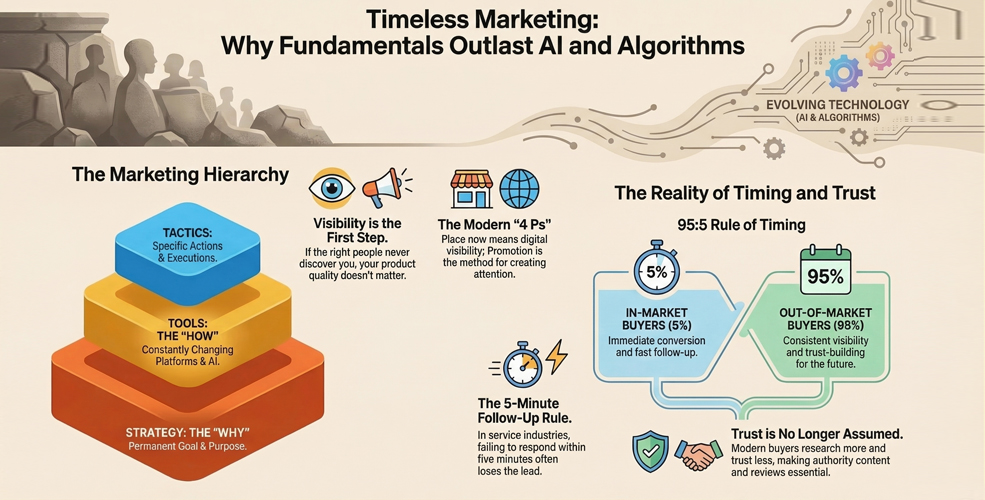
That sounds almost too obvious to say, yet it is one of the most common blind spots in small and midsize business marketing. Many companies focus on improving the service, refining the offer, or upgrading operations, all of which matter. But if the right people never discover the business in the first place, none of those improvements can do much heavy lifting.
That is the real role of marketing. At its core, marketing creates awareness and visibility. Sales comes afterward. In earlier decades, that visibility often came through physical presence, reputation, print, radio, signage, and word of mouth. Today, much of it comes through search, local listings, reviews, content, video, social platforms, and digital advertising. The channels changed. The job did not.
The 4 Ps Still Explain More Than People Think
Long before modern marketers were talking about omnichannel journeys and AI-enhanced personalization, business schools were teaching the Four Ps of Marketing: product, price, place, and promotion.
That framework may sound old, but it still explains a surprising amount of what works today.
Product
Product is still about fit. What are you offering, and what problem does it solve? Customers rarely care about a product or service in the abstract. They care about whether it helps them get where they want to go, avoid pain, save time, reduce risk, or improve an outcome.
Price
Price still shapes perception. Businesses often treat pricing as a pure finance decision, but customers interpret price psychologically. Too low can create doubt. Too high can create resistance. The right price supports the position you want to own in the market.
Place
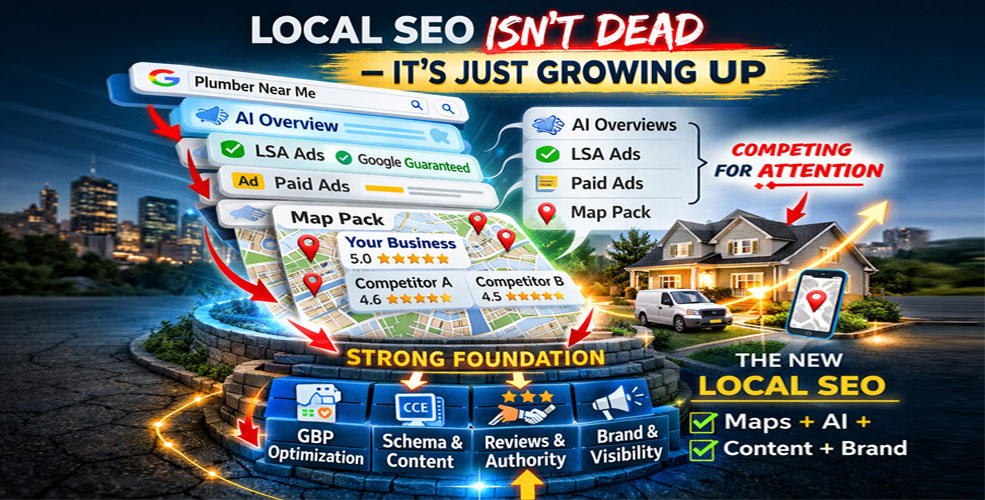
Place may be the most interesting one in the digital era. Traditionally, it meant physical distribution or store location. Today, it also means where your business shows up online. Search results, Google Business listings, industry directories, reviews, videos, social profiles, and helpful articles are all forms of place now. In many industries, online visibility has become the modern version of location advantage.
Promotion
Promotion is still how attention gets created. Whether that is SEO, content marketing, paid search, video, social media, email, or retargeting, the principle is unchanged. Promotion exists to help the right people discover you and understand why you matter.
Strategy, Tools, and Tactics Are Not the Same Thing
A lot of confusion in marketing comes from people mixing up strategy, tools, and tactics.
Strategy is the high-level thinking. It answers questions like: Who are we trying to reach? What problem are we solving? Why should someone trust us instead of the alternatives? How do we want to be remembered?
Tools are the platforms. Google is a tool. Facebook is a tool. YouTube is a tool. AI software is a tool. Marketing automation is a tool.
Tactics are the specific actions you take inside those tools. Writing a blog article is a tactic. Running a paid campaign is a tactic. Optimizing a service page is a tactic. Creating a remarketing sequence is a tactic.
This distinction matters because tools and tactics change constantly, while strategy changes much more slowly. Businesses that chase tactics without a clear marketing strategy and diagnosis often mistake movement for progress. They stay busy, but they do not become more visible, more trusted, or more memorable in the market.
“Location, Location, Location” Still Applies Online
There is a reason the old real estate phrase “location, location, location” became so well known. A business in the right place gets seen. A business in the wrong place struggles to get noticed, even if what it offers is excellent.
That same principle now applies online.
A business that only lives in one digital location is vulnerable. If all of your visibility comes from one social platform, one traffic source, or one type of campaign, you are building on borrowed ground. Stronger businesses show up in multiple places where prospects are already looking: search results, maps, reviews, blog content, videos, local citations, and social platforms.
That kind of distributed visibility matters because modern buyers do not move in a straight line. They search, compare, leave, come back, check reviews, browse again, and sometimes wait weeks or months before making contact. Businesses that are visible in several places have a better chance of being remembered when attention turns into intent.
Buyers Research More, and Trust Less
One reason marketing feels harder today is that trust is no longer assumed.
Consumers have more information than ever, but they also have more reasons to be skeptical. They have seen exaggerated claims, fake reviews, thin content, bad experiences, and overpromises. That has raised the standard. Being visible is no longer enough. You also have to feel credible.
Google consumer research shows that a large percentage of shoppers research businesses online before visiting a store or contacting a company. That means digital visibility often influences real-world purchasing decisions even when the final transaction happens offline.
Trust data points in the same direction. Edelman’s Trust Barometer research continues to show that trust is a major factor in purchasing decisions, reinforcing the importance of credibility, reputation, and consistent brand presence.
This is where authority content, reviews, case examples, and consistent brand presentation matter. Helpful content does more than fill a blog. It signals seriousness, experience, and clarity. It gives potential buyers more reasons to believe you know what you are doing.
Timing Is Still One of the Biggest Forces in Marketing
One of the most overlooked truths in marketing is that most people are not ready to buy right now.
That is not a failure of marketing. It is simply how markets work.
Research associated with the Ehrenberg-Bass Institute’s 95:5 rule argues that only about 5 percent of potential buyers are actively in market at any given time, while the remaining 95 percent are not ready yet. They may need the service later, but not today.
This has major implications for how businesses think about marketing. If someone has a plumbing emergency, the buying window is immediate. If someone notices their roof is aging, the buying window may stretch out for months. In both cases the need is real, but the timing is different.
That is why consistent visibility matters so much. The businesses that stay present, recognizable, and credible over time are the ones more likely to be remembered when the need becomes urgent.
The Customer Journey Is No Longer Linear
Older marketing models often described the path to purchase as a funnel. A customer becomes aware, develops interest, and then decides to buy.
That still works as a simplified model, but it does not describe how people actually behave very well anymore.
Today, someone might discover a business through search, read reviews, browse the website, leave, encounter a video later, see a social post a week after that, ask a friend, and only then decide to reach out. McKinsey has written about these more complex, multi-touchpoint journeys, where customers move across channels rather than through one neat, sequential funnel.
This is why modern marketing works best when multiple channels support each other. Search visibility, content marketing, social presence, reputation management, and paid promotion are not isolated activities. Ideally, they reinforce each other.
Sometimes the Marketing Works and the Business Still Loses
One of the more frustrating realities in marketing is that sometimes the campaign is not the real problem.
Leads come in, but calls are missed. Forms are submitted, but responses take too long. A front-desk interaction turns a good first impression into a bad one. The marketing did its job, but the business did not finish the process.
That matters because response speed still has a measurable effect on outcomes. Research cited in lead response studies has consistently shown that quick follow-up dramatically increases the chance of connecting with prospects. This highlights why focusing on quality leads over quantity is vital for business health.
In other words, marketing and sales experience are connected. Visibility gets the opportunity. Trust keeps the opportunity alive. Process determines whether the opportunity turns into revenue.
The Enduring Framework Behind It All
When you strip away the platforms, formats, buzzwords, and software, the framework is still fairly simple.
A business needs visibility.
Visibility needs reinforcement through repeated exposure.
Repeated exposure helps build trust.
Trust opens the door to contact.
Contact creates a sales conversation.
And the customer experience determines what happens next.
That sequence is not flashy, but it is durable. It worked before digital marketing. It works inside digital marketing. And it will still work after the current crop of tools gets replaced by the next one.
Why This Still Matters in 2026
The marketing world will keep changing. AI will continue to alter workflows, accelerate content production, and influence how campaigns get built and optimized. More platforms will appear. Others will lose relevance. That part is inevitable.
What is less likely to change is the underlying structure of how people buy. They still need to notice you. They still need enough trust to keep paying attention. They still need the timing to line up. And they still respond to clarity, consistency, and competence.
That is why marketing fundamentals still matter in a world of AI and algorithms. They are not old because they are outdated. They are old because they have survived.
If you are trying to determine whether your digital marketing strategy, online visibility, or follow-up systems are actually supporting growth, it often helps to step back and look at the bigger picture before chasing the next tactic.
TL;DR / FAQ
What is the main takeaway from this article?
The core idea is that while marketing tools keep changing, the fundamental principles of marketing remain the same. Businesses still need visibility, trust, timing, and strong follow-up systems to consistently attract and convert customers.
Do traditional marketing principles still apply in digital marketing?
Yes. Digital marketing simply provides new channels for applying the same timeless principles such as awareness, credibility, repetition, and trust building. The tools evolve, but human buying behavior remains largely unchanged.
Why is visibility so important for business growth?
If potential customers do not know your business exists, they cannot choose you. Visibility across search engines, maps listings, reviews, content, and social platforms helps ensure your business appears when customers begin researching solutions.
Why do trust and credibility matter more today?
Modern consumers research businesses before contacting them. Reviews, helpful content, brand consistency, and authority signals help reduce skepticism and build the credibility needed for customers to take the next step.
What role does timing play in marketing success?
Most people are not ready to buy immediately. Effective marketing keeps your business visible so that when the need becomes urgent, your company is the one customers remember and contact first.
Why do businesses sometimes lose leads even when marketing works?
Marketing may successfully generate inquiries, but slow response times, poor follow-up, or weak customer experience can still cause the sale to be lost. Marketing and sales processes must work together to convert opportunities.
How should businesses apply these marketing ideas in 2026?
Businesses should focus on consistent online visibility, building trust through helpful content and reviews, responding quickly to leads, and developing a clear marketing strategy instead of chasing every new platform or tactic.
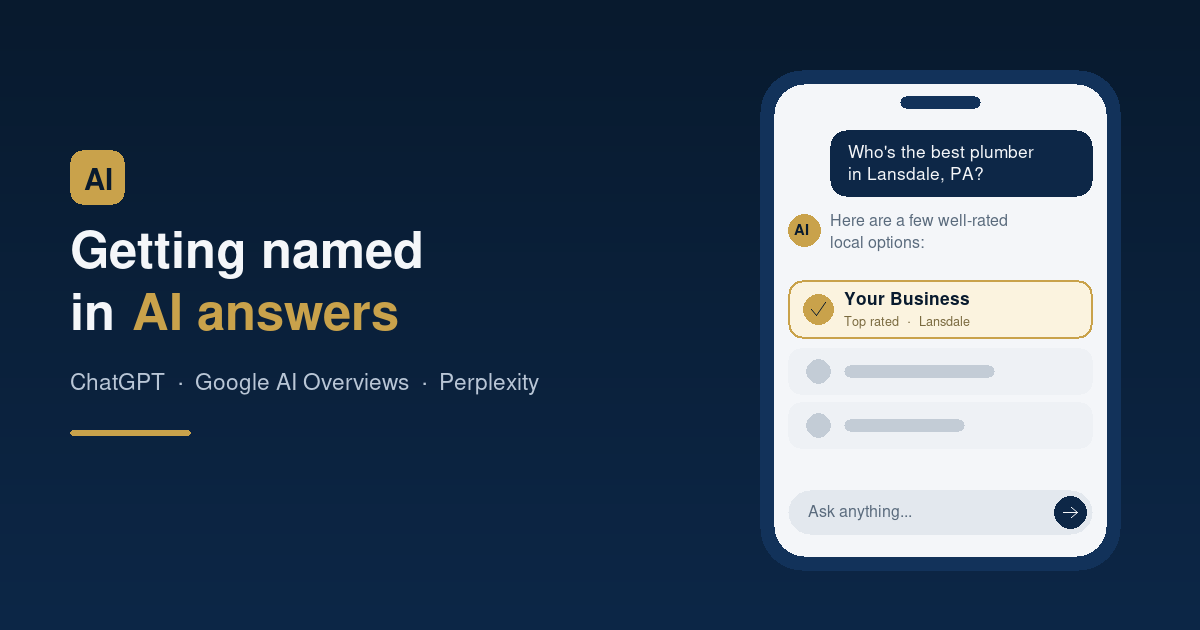
Fulcrum Concepts helps established service businesses get found across search, maps, and AI answers, then turn that visibility into calls and customers, with follow-up that catches every lead. If your marketing feels busy but the phone isn't ringing like it should, start a conversation and we'll tell you what we find.
Talk to us
Wondering how any of this applies to your business? Start with a straightforward conversation, no pressure, no canned pitch.