If you do marketing for home services businesses, you've heard it lately:
"SEO doesn't work anymore."
"Google ruined organic."
"It's all ads and AI now."
There's some truth in that. But here's the more accurate take: Local SEO isn't dead. It's just growing up.
And what we used to call "local SEO" - especially Maps and GBP visibility - is no longer the uncontested center of the page.
Let's Be Clear: Local SEO = Maps Visibility
When I talk about local SEO, I'm not talking about blog traffic. I'm talking about Google Business Profile visibility, Map Pack placement, proximity-driven search results, and call and direction clicks directly from Google.
For most home service companies, that's the core. That's where the phone rang. That's what drove steady lead flow. And yes - that visibility is getting pushed down too.
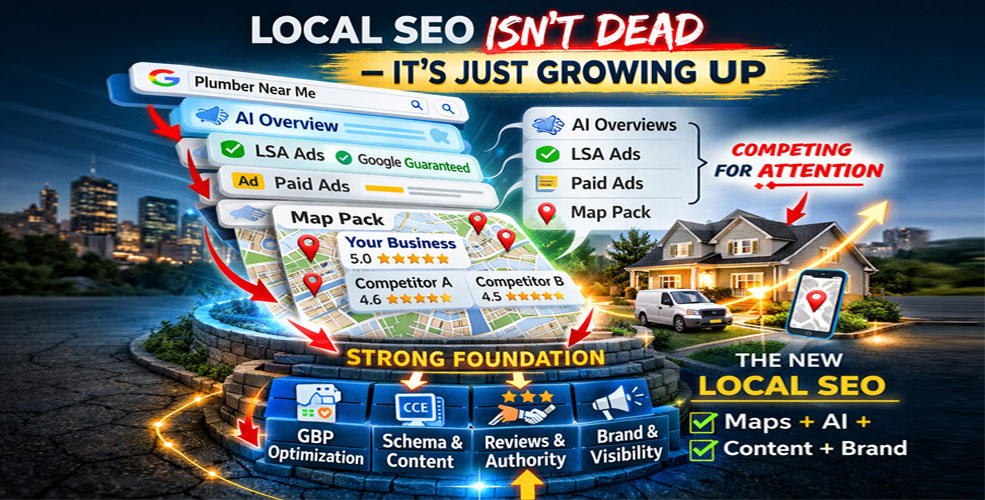
Now when someone searches "plumber near me," "AC repair in [city]," or "roof replacement contractor," they often see:
- LSA ads
- Google Guaranteed placements
- AI Overviews
- Paid ads
- Sometimes People Also Ask
- Then the Map Pack
In some searches, Maps still sits high. In others, it's compressed. And in some cases, AI overviews summarize businesses before the Map Pack even becomes the focal point.
This is where things get nuanced. Because sometimes the businesses showing up in AI overviews are not the same ones ranking in the top three Map positions. That's important.
Why the Map Pack Isn't What It Used To Be
There was a stretch of time when being in the top 3 in Maps meant steady call volume. That relationship is no longer linear in competitive markets.
Now, LSA can sit above Maps. AI overviews can pre-frame the decision. Paid ads stack higher. Mobile layouts compress visibility even further. Even if you're ranking #1 in Maps, you are sharing attention with multiple monetized and AI-generated layers.
That doesn't mean Maps stopped mattering. It means it's competing for oxygen. In dense Tier 1 and Tier 2 markets, that competition is intense. In smaller towns, you'll still see more traditional behavior. That's market maturity at work.
The AI Variable: Not Replacing Maps, But Competing With It
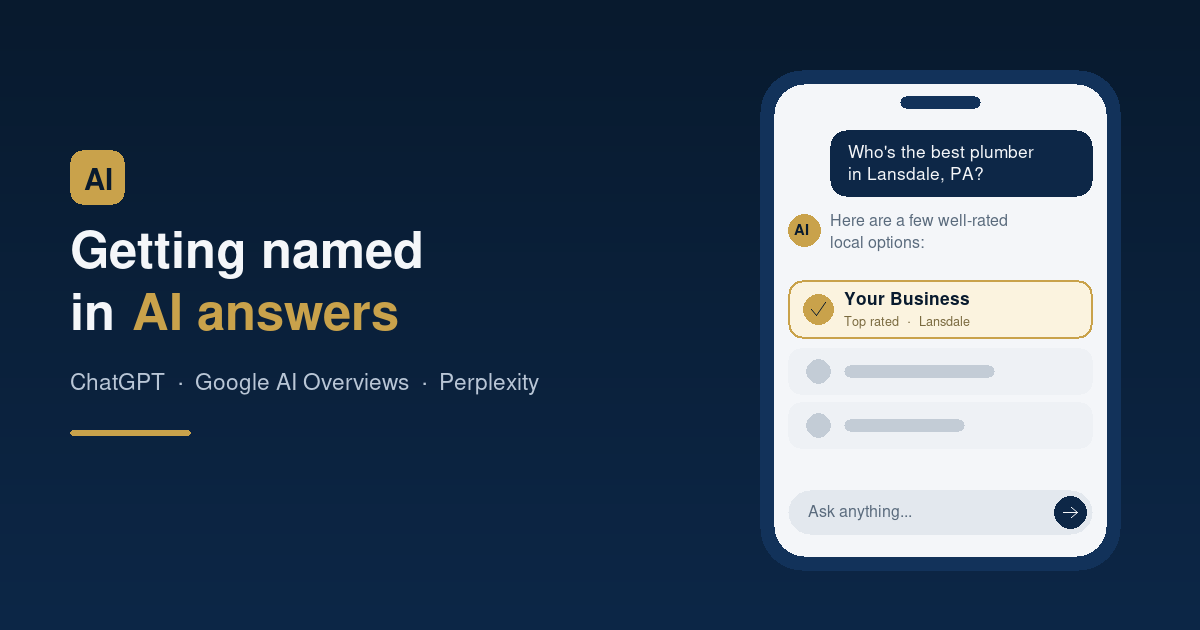
AI Overviews are interesting. Sometimes they reference businesses, pull in reviews, and mention local providers. Sometimes they don't. And sometimes they surface businesses that aren't the same ones dominating the Map Pack.
That tells us something important: AI visibility is not a carbon copy of Maps visibility. It's influenced by website structure, content clarity, schema markup, topical authority, entity recognition, review signals, and geographic relevance.
Maps ranking still heavily considers proximity and GBP optimization. AI summaries appear to weigh broader authority signals. That means the old "just optimize the GBP" mindset is incomplete now.
Maps is still core. But it's no longer the only layer influencing local visibility.
SEO Is No Longer a Channel - It's Infrastructure
Here's the part most people miss. In 2020, many businesses treated SEO - including Maps - as a traffic engine. In 2026, local SEO is infrastructure.
If your Google Business Profile is strong but your website is thin, inconsistent, or poorly structured, you are limiting both Map performance and AI interpretability.
When you invest in proper LocalBusiness schema, service schema tied to real offerings, FAQ schema aligned with real queries, structured headings, clear service explanations, consistent NAP data, internal linking that reinforces geography, and real review markup, you're strengthening both Maps authority signals and AI system comprehension.
AI doesn't "look at" your GBP the way a user does. It interprets structured signals across the web. So if your digital presence is fragmented, vague, or shallow, AI visibility becomes inconsistent.
That explains why some companies show strongly in Maps but not in AI summaries - and vice versa. It's layered now.
Search Behavior Has Shifted Too
There's another variable. Consumers don't always discover you through Maps first anymore. They see a local recommendation in a Facebook group, watch a short video, read an AI summary, hear your name from a neighbor, or notice your trucks around town. Then they search your name.
That branded search still depends heavily on GBP strength, reviews, website clarity, structured signals, and authority positioning. Google is increasingly a validation engine. Maps still matters. But so does everything supporting it.
Why Blogs and Content Actually Matter Again
Not for vanity traffic. Not for random keywords. For structure and authority.
If your website consists of a homepage, three service pages, and a contact page, you're thin in today's environment. AI systems favor structured answers, clear service breakdowns, geographic relevance, demonstrated expertise, and depth around specific problems.
Strategic content builds:
- Entity recognition
- Semantic strength
- Service clarity
- Internal reinforcement of Maps signals
- Broader authority for AI interpretation
It also gives you material to distribute across LinkedIn, YouTube, Facebook, and podcast platforms. Local SEO used to be largely GBP-centric. Now it's GBP plus structured digital authority.
Why It Feels Harder in Competitive Cities
If you're in a dense metro area, you feel this more. Because more businesses are optimizing, more are running LSA, more ad dollars are flowing, more content exists, and more monetization layers are active. Google extracts more value where demand supports it.
In smaller markets, Maps still carries disproportionate weight. In mature markets, it shares the stage. That's not unfair. It's evolution.
The New Reality of Local SEO
Local SEO today includes GBP optimization, review management, proximity signals, technical website structure, schema clarity, content authority, brand search growth, and multi-platform visibility.
If you're only optimizing your GBP and ignoring the rest, you're vulnerable. If you're only writing blogs and ignoring Maps, you're incomplete.
The businesses who win now build alignment between:
- Maps visibility
- Website structure
- Content depth
- AI interpretability
- Brand strength
That's what "growing up" looks like.
A Calm, Strategic Perspective
Yes, some companies are seeing 30–40% lead compression from Map and SEO-heavy models in competitive markets. That doesn't mean Maps died. It means it's sharing space, it's influenced by broader signals, and it's part of a layered ecosystem.
If Maps used to drive 70% of your leads and now drives 45%, that's still meaningful. But it cannot operate in isolation anymore. Your local rankings look fine. So why are calls disappearing?
Local SEO isn't dead. It is still relevant and clicks have decreased in more competitive areas, yet those 60% of clicks are still worthwhile for most home services businesses.
Here's What This All Means
Maps and GBP visibility are still core. They're just not the entire story. In competitive markets, the businesses that understand how Maps connects to structured SEO, AI signals, and brand presence will quietly widen the gap.
If you're profitable, growth-focused, and noticing the shift, this is the time to mature the approach - not abandon it. Learn more about how AI decides which businesses get seen.
FAQ's / TL;DR
Is local SEO dead in 2026?
No, but it's evolved. Maps visibility is still valuable, but it now shares space with AI Overviews, LSAs, and paid ads.
The businesses winning are those treating local SEO as infrastructure, not just a traffic channel.
Why are my Maps rankings good but calls are down?
Because Maps is competing for attention with multiple layers—LSAs, AI summaries, paid ads, and more.
Even a #1 Maps ranking shares visibility with monetized placements above it.
What's the difference between Maps SEO and AI visibility?
Maps ranking focuses on proximity and GBP optimization.
AI visibility weighs broader signals like website structure, schema markup, content authority, and entity recognition.
Do I still need to optimize my Google Business Profile?
Absolutely. GBP is still core. But it can't operate in isolation anymore.
It needs to be supported by proper website structure, schema, content, and brand signals.
What should I focus on if I'm in a competitive market?
Build alignment between Maps visibility, website structure, schema implementation, content authority, and brand presence.
The businesses winning now treat these as an integrated system, not separate channels.
How is AI changing local search?
AI Overviews sometimes surface different businesses than the Map Pack.
They prioritize structured data, content clarity, and topical authority—not just proximity.
Fulcrum Concepts helps established service businesses get found across search, maps, and AI answers, then turn that visibility into calls and customers, with follow-up that catches every lead. If your marketing feels busy but the phone isn't ringing like it should, start a conversation and we'll tell you what we find.
Talk to us
Wondering how any of this applies to your business? Start with a straightforward conversation, no pressure, no canned pitch.