Way back when I took my first marketing classes, one rule kept showing up over and over:
Location. Location. Location.
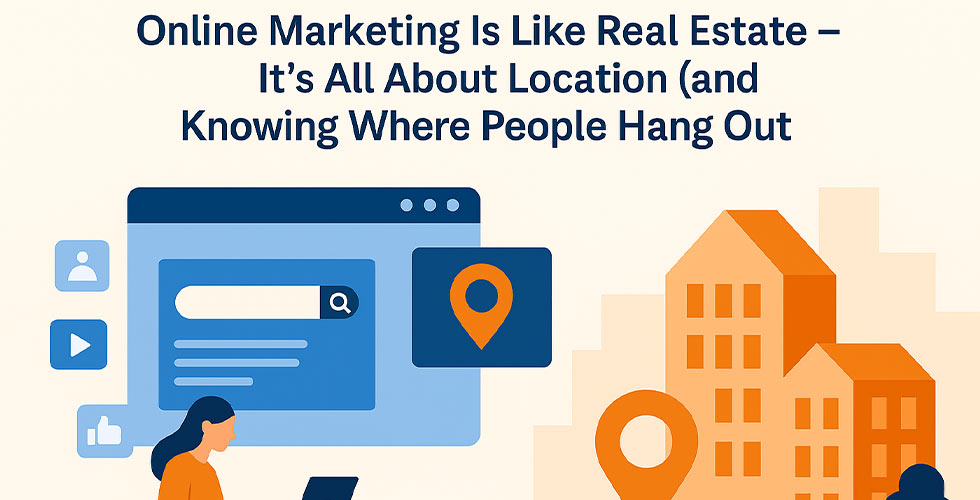
It was all about using real estate as an example, the idea that a property’s value isn’t just about what it is, but where it is.
Think about it:
You can have two condos built the exact same way. One sits in a safe, well-lit neighborhood near good schools and restaurants. The other’s tucked in a rougher area where you wouldn’t go out for an evening walk.
Same construction, different neighborhood... completely different value.
That same logic applies to making sure your business is seen online in the right neighborhoods - your online real estate.
The Coffee Shop Rule
Imagine opening a coffee shop.
You can save money by leasing a side street with cheap rent — or pay a premium for a corner spot right on Main Street. The high-traffic location gets more eyeballs, impulse buyers, and morning regulars.
You might say, “But my coffee’s better!” True, maybe it is. But if people don’t see you or can’t find you, it doesn’t matter.
Fast forward two years. That once-busy intersection isn’t so busy anymore. A new neighborhood across town is buzzing with life - remote workers, weekend foot traffic, new restaurants. Suddenly, that original location, the one that used to be gold, doesn’t feel like the place to be.
It’s not that it’s bad --> it’s just lost some of its “it” factor.
And that’s exactly what’s happening in digital marketing right now.
The “Old Neighborhood” of Google Search
For a long time, the best corner in town was Google Local Search. If you ranked high on Google Maps or held a top-three spot in the local pack, you owned the block. Leads could just roll in.
But now: many business owners report steep declines in localized map traffic, even when all the SEO fundamentals are intact. Google’s layout shifts, paid ads push organic results down, and the map pack isn’t as dominant as it used to be.
One source notes that in 2024, Google’s local map pack is being “lowered and deprioritized,” shifting it further down the search engine results pages.
According to data, businesses in the Google 3-pack historically receive significantly more actions (calls, clicks, direction requests) than those outside it. (https://redlocalseo.com) However that share of the pie has shrunk.
And Google itself has even investigated reported traffic declines following algorithm and layout changes. (https://searchenginejournal.com)
Search still matters --> it’s just no longer the only place to be.
Be Where Your Customers Actually Spend Time
Here’s the mindset shift:
People don’t spend all their time scrolling Google Search. They’re on social platforms, watching short-form video, interacting with brands in casual, human ways.
That doesn’t mean you abandon search — it’s still your “morning coffee shop.” But you also need that after-hours lounge — where your audience hangs out to unwind, engage, and absorb.
So today’s marketing might look more like this:
- Google Search → The morning rush location. People arrive with intent.
- Social Media / Video → The after-hours lounge. People consume, share, and remember.
- Warm Market Building - Using strategies to build warm audiences and offering useful content
- Email / Drip Content → Your “local club.” Familiar faces, consistent presence, and long-term loyalty.
You wouldn’t run a coffee shop that closes at noon if half your customers enjoy espresso cocktails later. So why limit your marketing to just one “neighborhood”?
The 3% vs. 97% Reality Check
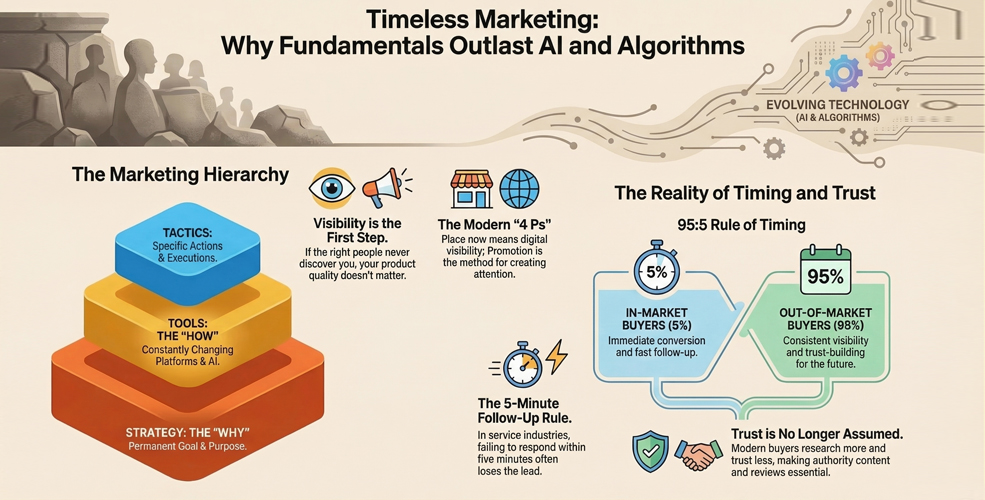
A commonly cited rule is that only about 3% of your market is actively in a buying mindset at any given moment. (stickybranding.com)
Others frame this in B2B terms as the “95/5 rule” - only 5% of buyers are actively in-market, while the other 95% are not yet ready but still represent future opportunities. (unboundb2b.com)
Another view (for quarterly buying cycles) suggests 9–11% of the total addressable market is ready to buy in any given quarter. (6sense.com)
If you only show up in one digital neighborhood, you only get access to that small percentage.
But if you plant presences across search, social, video, email... you stay top of mind with the 97 - 95% who aren’t ready yet. Over time, familiarity builds credibility, and credibility leads to trust.
The Digital Neighborhood Rule
In real estate, a savvy investor doesn’t own just one property. They diversify — one downtown, one near the beach, maybe a few in up-and-coming districts.
In marketing, the same principle applies:
- Keep your search presence strong: it’s your foundation.
- Add new “locations” where your audience spends time: social, podcasting, video, community forums.
- Stay consistent: digital neighborhoods evolve faster than physical ones.
You don’t need to abandon your original “coffee shop” you just open a second (or third) spot in the places people now congregate.
Online marketing isn’t about chasing every new trend, it’s about staying visible where your audience actually lives. The “good neighborhood” today might not be the hotspot next year. The smart brands hold multiple properties across the digital landscape.
If you’d like a quick sanity check on where your business “lives” online and how those digital neighborhoods are shifting
Fulcrum Concepts helps established service businesses get found across search, maps, and AI answers, then turn that visibility into calls and customers, with follow-up that catches every lead. If your marketing feels busy but the phone isn't ringing like it should, start a conversation and we'll tell you what we find.
Talk to us
Wondering how any of this applies to your business? Start with a straightforward conversation, no pressure, no canned pitch.